5 Government Exams You Can Clear in 6 Months
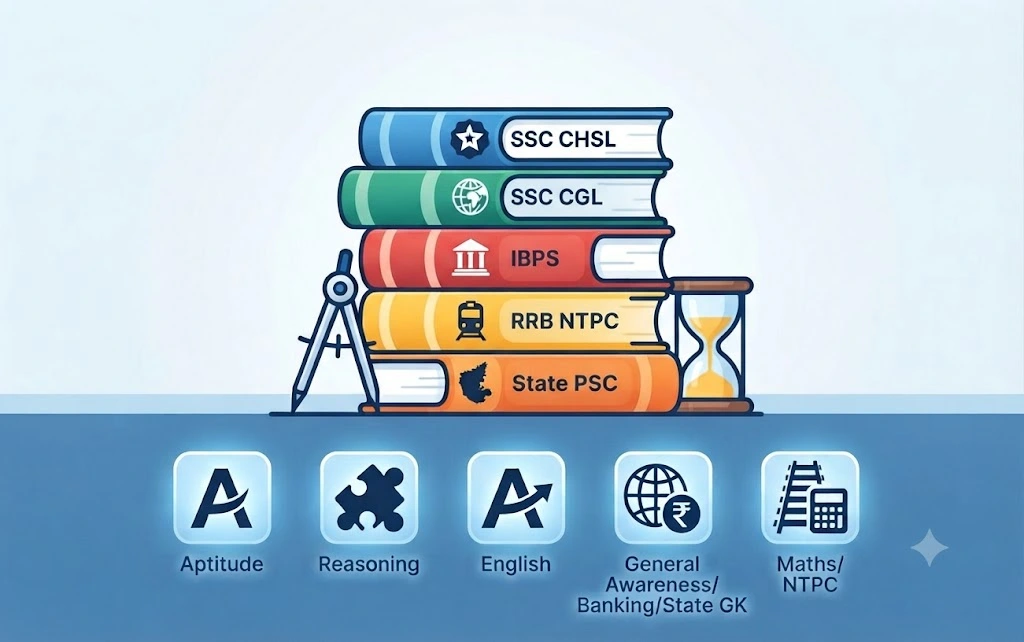
The 5 Exams Covered
| Exam | Typical Recruitment Area | Core Subjects | Why a 10-Month Plan Can Work |
| SSC CHSL | Central Government clerical/assistant roles | English, Reasoning, Quantitative, GK | Compact Tier-I syllabus and objective practice |
| SSC CGL | Central Government Group B/C posts | English, Reasoning, Quantitative, GK | Large but structured syllabus; strong overlap among sections |
| IBPS Clerk / CSA | Public-sector bank customer service roles | English, Reasoning, Numerical Ability | Highly practice-driven prelims; speed matters |
| RRB NTPC | Railway non-technical posts | Maths, Reasoning, General Awareness | Objective pattern and substantial common-syllabus overlap |
| State PSC/SSC-type Graduate Exam | State government posts | Language, GK, Reasoning, Quant | State-specific GK plus common aptitude preparation |
How to Choose
Choose the exam according to your qualification, age, preferred job type, willingness to relocate, and comfort with mathematics, English, reasoning and general awareness. Several exams share the same aptitude foundation, so preparing one core syllabus can keep multiple options open.
1. SSC CHSL
Staff Selection Commission Combined Higher Secondary (10+2) Level examination.
Eligibility & Recruitment Notes
- Generally aimed at candidates who have passed 12th standard; exact qualification and age requirements must be checked in the current notification.
- Posts and pay levels vary by recruitment cycle. Common roles have included clerical/data-entry-oriented positions.
- Selection can involve computer-based examinations and, for specific posts, skill or typing tests.
Main Preparation Areas
- English Language
- General Intelligence/Reasoning
- Quantitative Aptitude
- General Awareness
- Computer/typing or skill components where applicable
Detailed Syllabus Focus
- Arithmetic: percentage, ratio, average, profit and loss, time and work, time-distance, simple/compound interest, geometry and mensuration.
- Reasoning: analogy, classification, series, coding-decoding, syllogism, direction, blood relations, Venn diagrams and non-verbal reasoning.
- English: grammar, vocabulary, error spotting, sentence improvement, cloze test, comprehension and usage.
- General Awareness: current affairs plus history, geography, polity, economy, science and static GK.
Who Should Consider It?
Best suited for: 12th-pass candidates who want a central-government exam with a manageable objective-test structure.
6-Month Approach
Months 1–2: Build concepts and complete the basic syllabus. Month 3: Finish remaining topics and begin sectional tests. Month 4: Increase previous-year-question practice and timed sets. Month 5: Take full-length mocks and analyse mistakes. Month 6: Revision, mock tests, current affairs consolidation and exam-specific polishing.
2. SSC CGL
Staff Selection Commission Combined Graduate Level examination.
Eligibility & Recruitment Notes
- Generally requires a bachelor’s degree, subject to post-specific conditions in the current notification.
- Recruitment covers multiple Group B and Group C positions across central government departments.
- Different posts can have different eligibility, physical/medical or skill requirements.
Main Preparation Areas
- English Language
- General Intelligence & Reasoning
- Quantitative Aptitude
- General Awareness
- Computer/skill or additional stages where applicable
Detailed Syllabus Focus
- Quantitative Aptitude: number system, algebra, geometry, trigonometry, mensuration, statistics/probability basics where prescribed.
- Reasoning: analogy, series, coding-decoding, logical reasoning, matrix, classification, statement-based questions and non-verbal topics.
- English: vocabulary, grammar, comprehension, sentence correction, active/passive voice, narration and cloze tests.
- General Awareness: current affairs, history, geography, polity, economy, science and static GK.
Who Should Consider It?
Best suited for: graduates seeking a broad range of central-government career options.
6-Month Approach
Months 1–2: Build concepts and complete the basic syllabus. Month 3: Finish remaining topics and begin sectional tests. Month 4: Increase previous-year-question practice and timed sets. Month 5: Take full-length mocks and analyse mistakes. Month 6: Revision, mock tests, current affairs consolidation and exam-specific polishing.
3. IBPS Clerk / Customer Service Associate
Banking recruitment conducted through the Institute of Banking Personnel Selection; the post title and process can vary by cycle.
Eligibility & Recruitment Notes
- Graduation is generally required; exact age, educational and local-language conditions depend on the current notification.
- The recruitment process normally emphasizes objective aptitude, English and reasoning, with banking/general awareness components at the relevant stage.
- Candidates should check the participating-bank and state/UT rules in the current notification.
Main Preparation Areas
- English Language
- Numerical Ability / Quantitative Aptitude
- Reasoning Ability
- General/Banking Awareness
- Computer awareness may be relevant depending on the stage/pattern
Detailed Syllabus Focus
- Quant: simplification, approximation, number series, arithmetic, data interpretation and basic mathematical application.
- Reasoning: puzzles, seating arrangement, inequality, syllogism, coding-decoding, blood relation, direction and logical reasoning.
- English: reading comprehension, cloze test, error detection, fillers, para-jumbles and vocabulary.
- Banking awareness: banking terms, financial institutions, monetary policy basics, current economic and banking events.
Who Should Consider It?
Best suited for: graduates who are comfortable with timed aptitude practice and want banking-sector recruitment opportunities.
6-Month Approach
Months 1–2: Build concepts and complete the basic syllabus. Month 3: Finish remaining topics and begin sectional tests. Month 4: Increase previous-year-question practice and timed sets. Month 5: Take full-length mocks and analyse mistakes. Month 6: Revision, mock tests, current affairs consolidation and exam-specific polishing.
4. RRB NTPC
Railway Recruitment Board Non-Technical Popular Categories recruitment.
Eligibility & Recruitment Notes
- Eligibility varies by post; both undergraduate and graduate-level posts may be notified in different recruitment cycles.
- The recruitment process can include computer-based tests and additional stages such as typing/aptitude tests for specified posts.
- Post-specific medical and document requirements must be checked in the notification.
Main Preparation Areas
- Mathematics
- General Intelligence & Reasoning
- General Awareness
- Typing/aptitude components for specified posts
Detailed Syllabus Focus
- Mathematics: number system, decimals, fractions, percentage, ratio, profit-loss, time-work, time-distance, geometry, algebra and statistics basics.
- Reasoning: analogy, series, coding-decoding, mathematical operations, syllogism, puzzles, Venn diagrams and data sufficiency-type reasoning.
- General Awareness: current events, Indian history, geography, polity, economy, general science and railway-related/general knowledge areas prescribed by notification.
Who Should Consider It?
Best suited for: candidates interested in railway recruitment and willing to prepare strongly for maths, reasoning and general awareness.
6-Month Approach
Months 1–2: Build concepts and complete the basic syllabus. Month 3: Finish remaining topics and begin sectional tests. Month 4: Increase previous-year-question practice and timed sets. Month 5: Take full-length mocks and analyse mistakes. Month 6: Revision, mock tests, current affairs consolidation and exam-specific polishing.
5. State PSC / State SSC-Type Graduate Examination
State-level competitive recruitment for government departments. The exact examination name and structure differ by state.
Eligibility & Recruitment Notes
- Eligibility, age, reservation rules and qualification vary by state and post.
- State-specific General Knowledge, history, geography, polity, economy, language and current affairs can carry substantial importance.
- Selection may include prelims, mains, typing/skill tests, physical tests or interviews depending on the recruitment.
Main Preparation Areas
- General Studies / State GK
- Quantitative Aptitude
- Reasoning
- English and/or regional language
- Current Affairs
- Post-specific subjects where prescribed
Detailed Syllabus Focus
- Build a state-specific notebook covering history, geography, culture, economy, government schemes and important institutions.
- Prepare common aptitude topics alongside state GK so the same six-month plan also supports other exams.
- Practice previous papers to identify the exact weight given to language, state GK and aptitude in your target state’s recruitment.
Who Should Consider It?
Best suited for: candidates who want to work within their state and can devote serious time to state-specific General Knowledge.
6-Month Approach
Months 1–2: Build concepts and complete the basic syllabus. Month 3: Finish remaining topics and begin sectional tests. Month 4: Increase previous-year-question practice and timed sets. Month 5: Take full-length mocks and analyse mistakes. Month 6: Revision, mock tests, current affairs consolidation and exam-specific polishing.
A Common 6-Month Master Plan
Month 1 — Foundation
- Take one diagnostic test for each major section to identify strengths and weaknesses.
- Complete basic arithmetic, grammar fundamentals and core reasoning concepts.
- Create a current-affairs notebook and a formula/error notebook.
- Study 5–6 days a week and reserve one day for revision and analysis.
Month 2 — Syllabus Completion
- Cover the remaining high-frequency concepts in Quantitative, Reasoning and English.
- Begin systematic General Awareness/General Studies preparation.
- Start solving previous-year questions after every completed topic.
- Target accuracy first; speed comes after concepts become reliable.
Month 3 — Practice Phase
- Shift from mainly learning to a roughly 40:60 learning-to-practice ratio.
- Attempt sectional tests regularly.
- Track accuracy, time per question and repeated mistakes.
- Begin exam-specific current affairs and state/banking/railway topics where relevant.
Month 4 — Previous-Year Questions
- Solve previous-year papers in timed conditions.
- Analyse every wrong answer and every question that took too long.
- Revise formulas, grammar rules, vocabulary and static GK repeatedly.
- Introduce full-length mocks gradually.
Month 5 — Mock-Test Phase
- Take 2–4 full mocks per week depending on stamina and available time.
- Spend at least as much effort analysing mocks as taking them.
- Develop a section-attempt order that works for you.
- Prioritise accuracy and question selection over attempting every question.
Month 6 — Final Revision
- Use short notes rather than restarting textbooks.
- Revise high-frequency formulas, grammar, vocabulary, GK facts and current affairs.
- Take full mocks under exam-like conditions.
- Reduce new learning during the final days and focus on retention, calm execution and logistics.
Daily Study Plan — 6 Hours
| Session | Time | Work |
| Session 1 | 1.5 hr | Quantitative Aptitude: concept + practice |
| Session 2 | 1.25 hr | Reasoning: concepts + timed questions |
| Session 3 | 1 hr | English / Language |
| Session 4 | 1 hr | GK / General Studies / Current Affairs |
| Session 5 | 1 hr | Previous-year questions or sectional test |
| Session 6 | 15 min | Error-log and formula revision |
If you can study only 3–4 hours daily, retain the same structure but reduce the number of questions. Consistency is more important than a very long timetable that cannot be maintained.
Weekly Study Cycle
- Monday–Thursday: concept learning + topic practice.
- Friday: mixed practice and weak-topic repair.
- Saturday: sectional or full mock depending on preparation stage.
- Sunday: detailed mock analysis, revision and current-affairs consolidation.
How to Use Previous-Year Questions
- First solve questions topic-wise without worrying about time.
- Mark questions as Correct, Wrong, Guessed or Too Slow.
- Record the rule/concept behind every repeated mistake.
- After two or three revisions, solve the paper under a strict time limit.
- Compare your accuracy and average time with earlier attempts.
Mock-Test Analysis Sheet
| Metric | What to Record | Why It Matters |
| Attempts | Number attempted | Shows question-selection strategy |
| Correct | Number correct | Measures usable knowledge |
| Wrong | Number wrong | Identifies accuracy problems |
| Unattempted | Questions left | Shows speed/time management |
| Time | Section-wise time | Helps improve pacing |
| Repeated Errors | Topic/rule | Tells you what to revise |
High-Priority Topics Across Multiple Exams
| Quantitative | Reasoning | English | GK/GS |
| Percentage | Series | Error spotting | History |
| Ratio & proportion | Coding-decoding | Fillers | Geography |
| Average | Syllogism | Cloze test | Polity |
| Profit & loss | Blood relation | Comprehension | Economy |
| Time & work | Direction | Vocabulary | General Science |
| Time, speed & distance | Puzzles | Sentence improvement | Current Affairs |
| SI/CI | Analogy/classification | Grammar | State/Banking/Railway GK |
| Geometry & mensuration | Seating arrangement | Para-jumbles | Static GK |
Books & Study Resources: How to Choose
Avoid collecting too many books. For each subject, choose one reliable concept source, one question bank or previous-year-question source, and a good mock-test platform. The exact edition should match the current exam pattern where possible.
- Quantitative Aptitude: one competitive-exam arithmetic source + previous-year questions.
- Reasoning: one standard reasoning book + topic-wise previous-year questions.
- English: one grammar/vocabulary source + previous-year questions + regular reading.
- General Awareness: one static-GK source + current-affairs notes.
- Banking exams: add banking/financial awareness to the GA plan.
- State exams: add a state-specific GK/history/geography source.
- Mocks: use timed sectional tests first, then full-length mocks.
Common Mistakes That Waste Six Months
- Changing books or teachers every few weeks.
- Watching lectures without solving enough questions.
- Ignoring previous-year papers until the final month.
- Studying only strong subjects and avoiding weak ones.
- Taking mock tests without analysing them.
- Trying to memorise current affairs without revision.
- Preparing for five different syllabi from scratch instead of building a common aptitude base.
- Neglecting typing, computer, language, physical or other post-specific requirements when they apply.
A Practical Multi-Exam Strategy
A candidate can build a common foundation for SSC, banking and railway examinations because Quantitative Aptitude, Reasoning, English and General Awareness overlap substantially. After the common foundation is strong, add the exam-specific layer: banking awareness for bank exams, railway/post-specific requirements for RRB recruitment, and state-specific GK/language for state recruitment.
- Core preparation: Quantitative + Reasoning + English + General Awareness.
- Exam-specific layer: add only after the common topics are under control.
- Application strategy: apply only when you meet the current notification’s eligibility requirements.
- Do not rely on a single exam date; recruitment calendars can change.
Final 30-Day Checklist
- Complete at least one full revision of every major topic.
- Maintain a compact formula and grammar notebook.
- Revise current affairs using a reliable monthly compilation.
- Solve recent previous-year papers in timed conditions.
- Take regular full-length mocks and analyse them.
- Keep application documents, photographs, signatures and identification details ready.
- Check the official recruitment website for the latest admit-card, exam-date and instruction updates.
- Sleep adequately before the examination and plan travel to the centre in advance.
Final Takeaway
Six months can provide a structured preparation window for several Indian government recruitment exams, provided the candidate starts with the correct eligibility, follows the current notification, builds strong common aptitude fundamentals, solves previous-year questions, takes timed mocks and repeatedly repairs weak areas. The objective should be measurable improvement each week rather than simply completing a large number of chapters.
— Start Your Preparation at TGE Coaching Today!
[BOOK FREE COUNSELING SESSION] – Let our experts guide you!